
Bells
Resonance of Faith
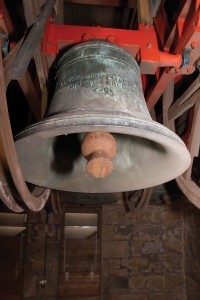
Of the fifty or so towers outside of England where the bells are hung in the English way, there are three in British Columbia: Christ Church Cathedral in Victoria, Westminster Abbey in Mission and Holy Rosary Cathedral.
The solemn blessing or “baptism” of the bells at Holy Rosary took place on Sunday, October 21, 1900. At the time there was a ring of seven bells, named after the seven Sacraments. They were not hung for change ringing at first. At the time they cost $9,000 and were cast in Savoy, France. They ranged in weight from 700 lbs. (318 kg.) to 5,000 lbs. (2,273 kg.).
The bells were shipped across China and the Pacific Ocean to Vancouver. The bells were not tuned to scale and therefore not melodic. So it was decided to send them to an English Foundry near Bristol. Some of the bells were melted down and recast to make a ring of eight tuned bells—a full octave.
After a third oceanic crossing they were finally re-hung for change ringing in 1906. The heaviest weigh 16 hundredweight, or 1,700 pounds. Mr. Alfred Limpus was the one who initiated the changes and was Ring Master for many years.
Change Ringing
Change ringing differs from other forms of bell ringing in which the bells are “hanging dead” with the mouth of the bell down and swung gently, or stationary, with the clapper moved against it. Each change-ringing bell, on the other hand, is connected to a wheel and rope, by means of which it is swung through a full circle each time it rings. This arrangement allows the bell to produce a fuller note than it would if hung stationary.
The equipment needed for change ringing is shown in the diagram. The bell is in the “set” position. When the ringer pulls the rope the bell will swing through a full 360 degree arc, the stay and the slider preventing the bell’s continuing for an extra revolution in one direction and winding up the rope. The stay is designed to break if struck with such force that the bell might otherwise shatter.
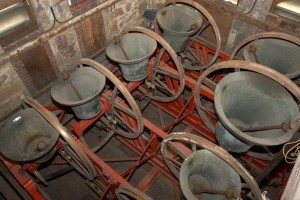
Bells hung for change ringing (called a “ring” of bells) may vary in number from four to twelve—the Cathedral has a “ring” of eight bells. They are arranged in a frame so that their ropes fall in a circle in the ringing chamber. Into each rope is woven a three-foot-long tuft of brightly coloured wool, called the “sally,” which allows the ringer to catch and pull the rope with a minimum of damage to the hands and which serves as a visual clue to where the bell is ringing in relation to others.
Ringing changes is simply varying the order in which the bells strike. This is accomplished by slowing down one bell and speeding another so that the two trade places in the sequence. The rules of change ringing call for no bell to move more than one position at a time, though more than one pair can change places.
Hundreds of methods have been composed for change ringing, and new ones are published almost weekly. They come with simple names like “Little Bob” and “Grandsire” or with more exotic titles like “Francis Genius Delight” and “Annabelle’s London Surprise.”
The first peal rung in Canada was at Holy Rosary Cathedral on Dominion Day, July 1, 1911. A tablet in the ringing chamber commemorates this event. There were 5,040 changes and it took two hours and fifty-nine minutes.